eSupervisor Detail

Get to know about the eSupervisor in depth

Hoime Banerjee Profile Picture

Research Scholar

Hoime Banerjee

Bioinformatics

Maharashtra, India
5 Years
Joined Apr 2026
Iit Bombay
Bioscience And Bioengineering
0 Consultations

About me

During PhD, I studied zebrafish brain development, focusing on a Tbox transcription factor involved in neural development. I mapped its spatial expression using in situ hybridization and identified expressing cell types with specific biomarkers. I analyzed RNAseq datasets to find downstream targets and performed motif analysis to predict regulation. I also overexpressed the factor in specific cells to assess its role in neural development. In my MTech, I have worked on protein purification.

Interests: My research interests focus on integrating experimental and computational techniques to study gene regulation and function. I am interested in spatial gene expression analysis, cell-type identification, and transcriptomic approaches such as RNA-seq. Overall, I aim to combine wet-lab and bioinformatic tools to understand how gene expression controls cellular identity.
Skills

BioinformaticsMolecular BiologyData ScienceR programmingPython ProgrammingGithubNeuroscienceNeuroinformaticsImage analysisData VisualizationData analysisFACSImmunostainingCryosectioningTissue processingRNA seqChiP seqBiological databaseProtein structure prediction

Certifications

Finlatics-Data Science with PythonElite-NPTEL Online certification

My Services

Transcriptomics: Analysis of RNA seq data from raw files - Research Decode Consultancy Cover Image

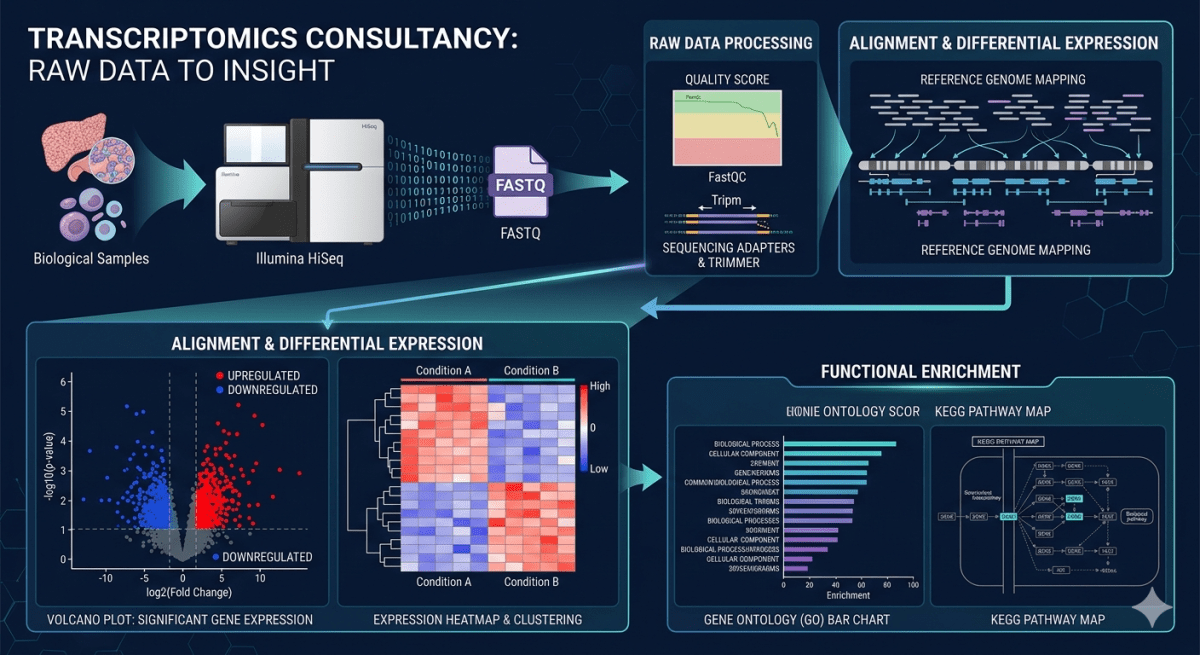
Transcriptomics: Analysis of RNA seq data from raw files

In the era of high-throughput sequencing, the bottleneck is no longer generating data—it’s interpreting it. Our consultancy provides end-to-end bioinformatics solutions to transform your raw FASTQ files into publication-ready figures and actionable biological hypotheses.Our Core ServicesRaw Data Processing & QC: Rigorous quality control using FastQC and MultiQC, followed by adapter trimming and contamination removal to ensure data integrity.Alignment & Quantification: Efficient mapping to reference genomes (using STAR, HISAT2, or Salmon) and transcript quantification.Differential Gene Expression (DGE): Robust statistical analysis using industry-standard tools like DESeq2 or EdgeR to identify significant fold changes between experimental groups.Functional Enrichment: Go beyond gene lists with Gene Ontology (GO) and KEGG pathway analysis to understand the "so what" of your data.Custom Visualization: High-quality Volcano plots, Heatmaps, PCA plots, and MA plots tailored for high-impact journals.The WorkflowConsultation: We discuss your experimental design (replicates, conditions, and batch effects) to ensure the statistical model is sound.Analysis: We execute a reproducible pipeline, typically using Snakemake or Nextflow, ensuring every step is documented.Reporting: You receive a comprehensive HTML or PDF report containing methodology, results, and interactive visualizations.Support: Post-analysis walkthrough to help you interpret the results and prepare for manuscript submission or downstream validation.

₹500

Session

₹4000

Project
Hoime Banerjee

Hoime Banerjee

5 Years experience
Protein structure prediction and target identification using bioinformatics tools - Research Decode Consultancy Cover Image

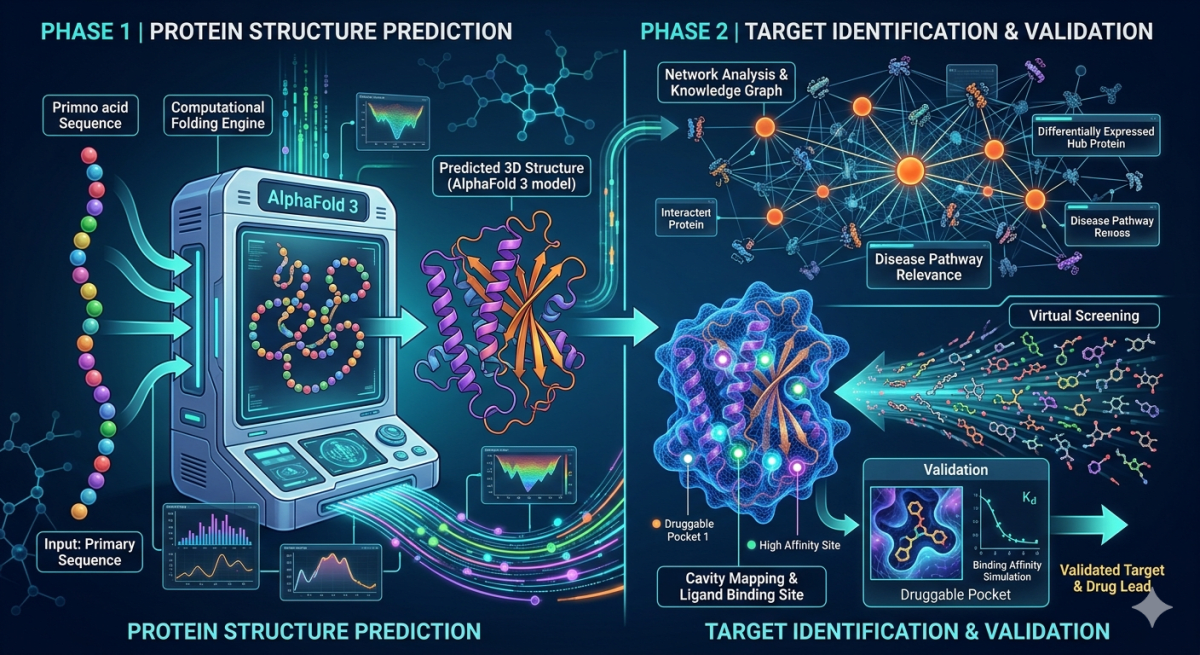
Protein structure prediction and target identification using bioinformatics tools

Protein Structure Prediction: The Deep Learning RevolutionPredicting the 3D shape of a protein from its amino acid sequence is critical for understanding function and designing drugs.The AlphaFold 3 EraWhile AlphaFold 2 revolutionized single-protein folding, AlphaFold 3 (and its competitors like RoseTTAFold All-Atom) has expanded the scope to include:Complex Assemblies: Predicting how proteins interact with DNA, RNA, and ligands (small molecules) in a single model.Ion & Modification Handling: Accurate modeling of metal ions and post-translational modifications (PTMs).Antibody-Antigen Modeling: Significant improvements in predicting the specific interfaces of immune complexes.2. Target Identification: Pinpointing the "Druggable" NodeTarget identification is the process of finding the specific biological entity (usually a protein) whose activity can be modified by a drug to achieve a therapeutic effect.Multi-Omics Integration: Tools like sc2DAT or Open Targets integrate genomic (mutations), transcriptomic (RNA levels), and proteomic data to see which genes are consistently dysregulated in a disease.Network Analysis & Knowledge Graphs: Instead of looking at one gene, we look at the "interactome." Tools like STRING or platforms using Neo4j (knowledge graphs) identify "hubs"—proteins that connect many pathways. If you hit a hub, you hit the disease harder.Synthetic Lethality Screening: Using bioinformatics to identify pairs of genes where the loss of both is fatal to a cancer cell, but the loss of one is not. This is used to find targets like PARP for BRCA-mutant cancers.

₹500

Session

₹4000

Project
Hoime Banerjee

Hoime Banerjee

5 Years experience