Senior Research Fellow
Devika Rajan
Scientific Writing
About me
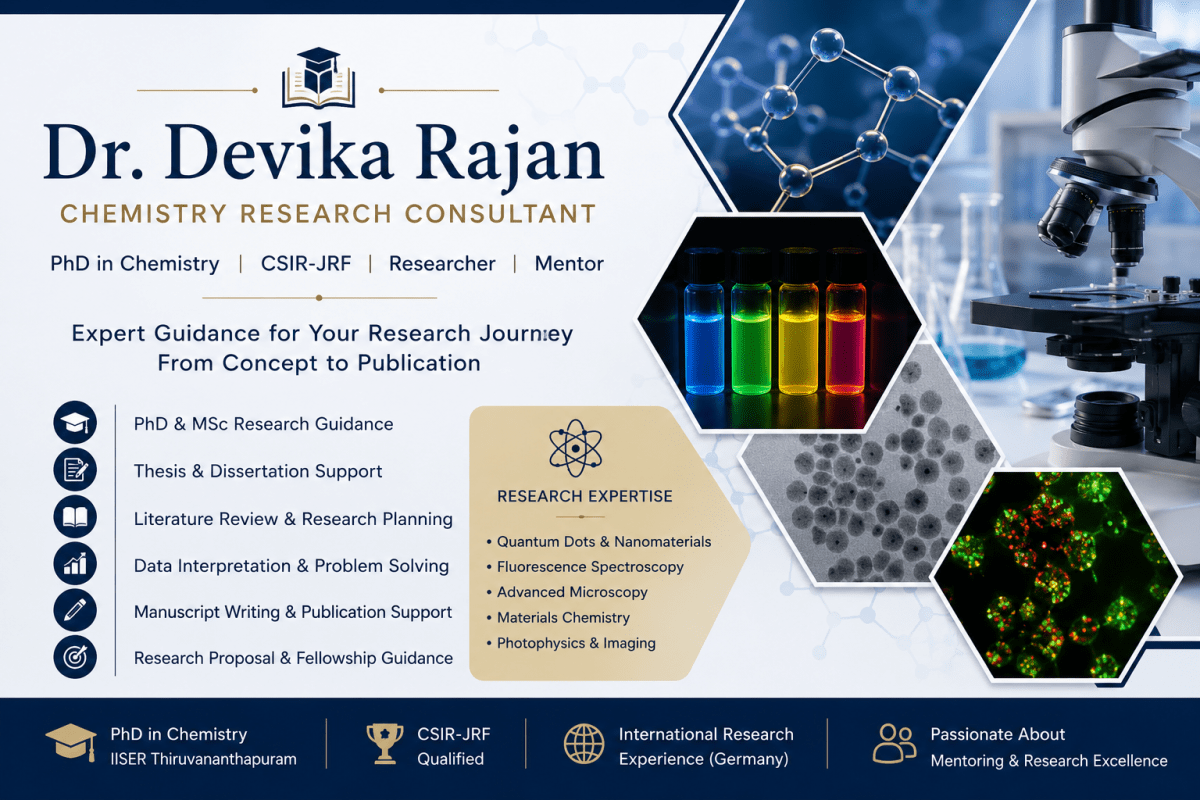
I completed my PhD in Chemistry with a strong research background. I have qualified the prestigious CSIR-JRF and have several years of experience in advanced chemical research. I believe that I have strong skills in scientific writing, proofreading, and communication. I can help them in scientific writing, as I have already co-authored several manuscripts in international journals. My expertise in this field will surely help me provide a new path for helping my students in scientific writing.
Interests: My doctoral research lies at the intersection of nanomaterials chemistry and photophysics, with a focus on understanding and engineering the optical properties of semiconductor quantum dots (QDs). In particular, the thesis explored variations in the ensemble- and single-particle-level photophysics of colloidal indium phosphide (InP) QDs through synthetic and post-synthetic modifications. The first chapter investigates how incorporating gallium (Ga) into the QD lattice influences the emission characteristics and blinking dynamics of InP QDs, as well as their fluorescence lifetime imaging (FLIM) and antibunching analyses. Interestingly, the addition of Ga increases the ON-time fraction in blinking dynamics, also confirmed by statistical analysis demonstrating its promise as a tool to improve the optical quality of InP QDs. Further, we have explored InP QDs as Förster resonance energy transfer (FRET) donors with potential biological applications. We have used water-soluble InP/GaP/ZnS QDs, denoted as InP(G), as FRET donors in combination with an acceptor protein, mCherry. Selective one and two-photon excitation of InP(G) in the presence of mCherry results in a quenching of QD emission and a corresponding enhancement in mCherry fluorescence. We have also investigated the modulation of charge-carrier dynamics in core-only InP QDs via post-synthetic surface modifications with ligand indium fluoride (InF₃). Single-particle studies are conducted to further investigate the influence of InF₃ treatment on InP QDs. Overall, the findings establish viable strategies for engineering high-quality InP QDs, advancing their potential in next-generation optoelectronic and biological systems.